Poncia
The House of Bernarda AlbaPoncia is Bernarda Alba’s sixty-year-old housekeeper and a long-serving member of the household, where she has worked for thirty years. Her practical intelligence and earthy humor make her one of the family’s most perceptive observers, but her employment leaves her subject to Bernarda’s contempt and control. She can read the dangers gathering among the daughters; she cannot make Bernarda acknowledge them. Her uneasy position—as servant, confidante, critic, and participant in the household’s rules—makes her a crucial witness to how oppression and fear pass through the house.
Identity and Position
Poncia enters the play after attending the church service for Bernarda’s recently deceased husband, Antonio María Benavides. While Bernarda remains at the service, Poncia returns to the house and steals food, an early sign of her resentment toward the mistress who dominates both family and servants. Her appetite and candor cut across the formal mourning ritual: the household’s public observance of respectability sits beside the private resentments created by Bernarda’s rule.
The commentary describes Poncia as typical of her class in her practicality and earthiness, yet distinctly individual. She takes pleasure in the priest’s chanting, recounts Paca la Roseta’s sexual exploits, and remembers the visit of the man who became her husband. Her comic account of his approach to her window gives her a lively, worldly voice. At the same time, the account of her widowhood suggests that past pleasures are now recalled rather than lived. Her worldly knowledge is therefore both a resource in dealing with the younger women and a reminder of the limits imposed by age and circumstance.
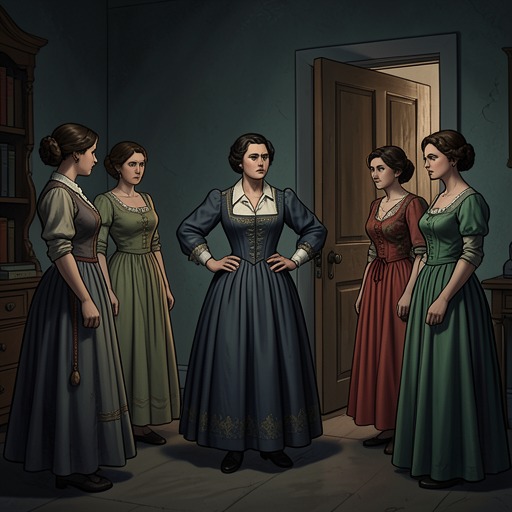
Poncia occupies a defined place in the domestic hierarchy: the Servant ranks below her, while Poncia herself remains subordinate to Bernarda. Bernarda’s treatment of her is abusive and exploitative, and the play’s commentary stresses that Poncia’s position does not protect her from the household’s class relations. Yet her seniority and long service give her a detailed understanding of Bernarda’s habits and the daughters’ conduct. She uses that knowledge to survive, to challenge her mistress indirectly, and to warn the family when private tensions become dangerous.
Practical Counsel and Adela’s Desire
In Act Two, Poncia advises Bernarda’s daughters about men and marriage, drawing on experience rather than idealized notions of courtship. Her earthy account of her own meeting with her future husband gives the girls an example of sexual knowledge they otherwise lack. She recognizes, however, that the central danger in the room is not their curiosity but Adela’s growing attraction to Pepe el Romano.
Poncia challenges Adela over her behavior when Pepe came to court Angustias, recalling that Adela had stood nearly naked with the light on and the window open. When Adela denies it, Poncia tells her to leave her sister alone and bear her feelings. She nevertheless offers a possible future: Angustias is delicate, she argues, and might not survive childbirth; if she died, Pepe could marry the younger and more beautiful Adela. The advice is not simply encouragement. Poncia urges Adela to wait, forget him for the present, and not go against religious law. Adela rejects the counsel angrily, and Poncia refuses to be silenced. Their exchange exposes a hard limit of Poncia’s practical wisdom: she can see the desire and the danger, but her proposed solution still accepts marriage and family circumstance as the terms within which Adela must live.
Poncia also understands that the conflict is broader than Adela’s attraction. She tells Bernarda that the daughters have not been left free and points to Martirio’s thwarted prospect of marrying Enrique Humanes. Bernarda confirms that she deliberately stopped the match because the man’s father had been a farm laborer: she would not allow her family’s blood to join with theirs. Poncia’s warning thus connects the daughters’ constrained choices to Bernarda’s class prejudice as well as her authority. When Poncia suggests that Pepe might be better married to Martirio or Adela, Bernarda dismisses the idea; Poncia pointedly identifies Adela as Pepe’s true fiancée, despite Angustias’s formal engagement.
Knowledge, Resistance, and Respectability
Poncia’s relationship with Bernarda is built on unequal power, but not on simple submission. Because she has served in the house for decades, she knows Bernarda’s strengths and weaknesses and becomes adept at turning that knowledge to her own advantage. She steals food, and she repeatedly makes pointed remarks about the daughters that plant doubts in Bernarda’s mind. Her warning that Pepe has been seen speaking with Angustias at half-past four in the morning is a particularly consequential intervention. It is also, as the commentary observes, a quiet moment of triumph: Bernarda has taunted Poncia about her mother’s dubious reputation, and Poncia now forces her mistress to confront information she would prefer not to hear.
That resistance does not make Poncia free of the values she criticizes. She shares Bernarda’s concern for reputation and fears the shame that scandal might bring in her old age. Her insistence that she wants to live in a respectable house echoes her mistress’s preoccupation with public judgment. The difference is one of power and degree: Bernarda enforces the code from a position of wealth and authority, while Poncia seeks security within a household whose rules she did not make. Her warnings can unsettle Bernarda, but she cannot escape the social standards that make respectability a condition of safety.
The play also sets Poncia’s complicity beside her awareness of injustice. When the unmarried daughter of Librada gives birth, kills the child, and hides the body, dogs uncover it, and villagers pursue her, Poncia reports both the circumstances and the crowd’s approach. Bernarda urges the villagers to kill the young woman; Poncia’s account makes the episode a test of the household’s moral order, exposing how the demand to conceal sexual shame can turn into communal violence. The commentary connects this honor code to a historical legal context: Spain’s 1870 Penal Code allowed a husband to claim the right to cleanse his honor with blood in specified cases, and the provision was not removed until 1963. That history does not make the villagers’ pursuit a formal legal proceeding; rather, it helps distinguish the play’s depiction of socially licensed honor violence from the law itself. Poncia conveys the threat, but the evidence does not present her as able to stop it.
Warnings and the Limits of Intervention
As the household grows more tense, Poncia understands that Bernarda’s outward authority conceals a crisis. She tells Bernarda that something serious is happening and argues that her daughters have not been allowed freedom. Bernarda, instead of heeding the warning, reminds Poncia of her origins and her status as a servant. The rebuke makes the limits of Poncia’s influence plain: her knowledge may be accurate, but Bernarda can still dismiss the person who brings it.
In a private conversation with the Servant, Poncia admits that she tried to prevent events from developing but is now frightened by them. She compares Bernarda’s willful refusal to see what is happening with a blindfold, then describes the silence in the house as concealing a storm in every room that will sweep them all away when it breaks. Her image gathers the play’s domestic pressures into one forecast: silence has not removed conflict; it has allowed it to accumulate beyond the household’s control. She also refuses to assign all responsibility to Pepe. She recalls that he pursued Adela the previous year and that Adela was deeply attracted to him, but adds that Adela should have stayed in her place and not provoked him, concluding that men will be men. The remark reveals the gendered double standard that survives even in Poncia’s clear-eyed assessment: she sees Bernarda’s repression and Pepe’s role, yet still places some responsibility on Adela for violating the expected limits on women.
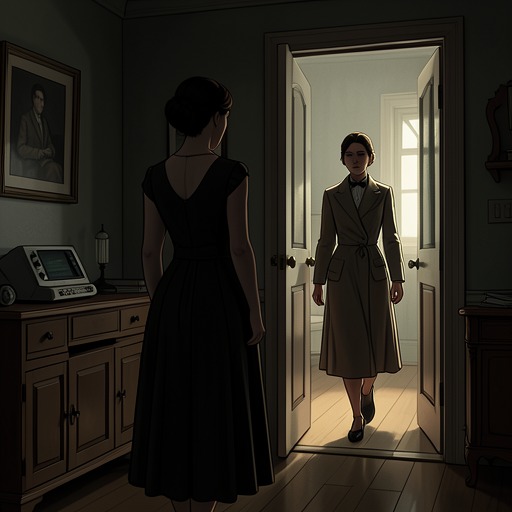
Poncia’s caution culminates in a final attempt to prevent Bernarda from entering after Adela’s death. Bernarda refuses, insists that Pepe has escaped, and orders that Adela be dressed as a virgin and that no one speak of the truth. Poncia’s warning cannot stop the cover-up, just as her earlier warnings could not persuade Bernarda to confront the daughters’ relationships. The ending confirms both her proximity to the family’s tragedy and her powerlessness within its hierarchy: she understands the danger, but Bernarda retains control over what the household will say.
Narrative Role and Significance
Poncia serves as a practical interpreter of the action. She notices the late-night visits, speaks openly about marriage and sexual reputation, recognizes Adela’s attachment to Pepe, and warns Bernarda that the family’s tensions are becoming unmanageable. Through her, private behavior becomes legible before Bernarda is willing to admit its meaning. Yet her insight never becomes authority: the person who can read the crisis is still commanded to work and keep quiet.
Her character also shows repression reproducing itself across class lines. Bernarda’s cruelty toward Poncia and the Servant does not prevent cruelty from being directed downward: the commentary notes that the Servant, herself exploited by Bernarda and by Bernarda’s late husband, coldly dismisses a beggar woman and is willing to steal food in retaliation. Poncia likewise strikes back through theft and insinuation rather than escaping the structure that constrains her. Such actions complicate any simple division between oppressor and victim without erasing the difference in their power.
The play’s broad realism places Poncia inside a recognizable rural social order of domestic labor, gendered expectations, and close communal scrutiny. The commentary links those conditions to Lorca’s stated ambition to write modern plays about the ills of contemporary Spain and to his description of the drama as a photographic documentary. Poncia’s household knowledge makes that social world concrete: she sees how reputation governs conduct, how class restricts marriage, and how Bernarda’s demands for silence leave the daughters with no safe way to express conflict. Later productions’ continued attention to the play’s universal vision and relevance further underscores the reach of this domestic drama, but Poncia’s significance is already contained in her repeated, failed warnings: she can name the storm, not command the house to open its doors.